A Weekend Issue Built Around One Reader Question
Build a weekend newsletter issue around one reader question, choose the right editorial approach, and keep every angle useful and coherent.
What would make a reader give a weekend issue their unhurried attention? A newsletter built around one reader question offers a clear answer: it gives the edition a centre, then makes each item earn its place by helping the reader think about that question. The useful choice is not simply what to include, but how tightly to organise the material.
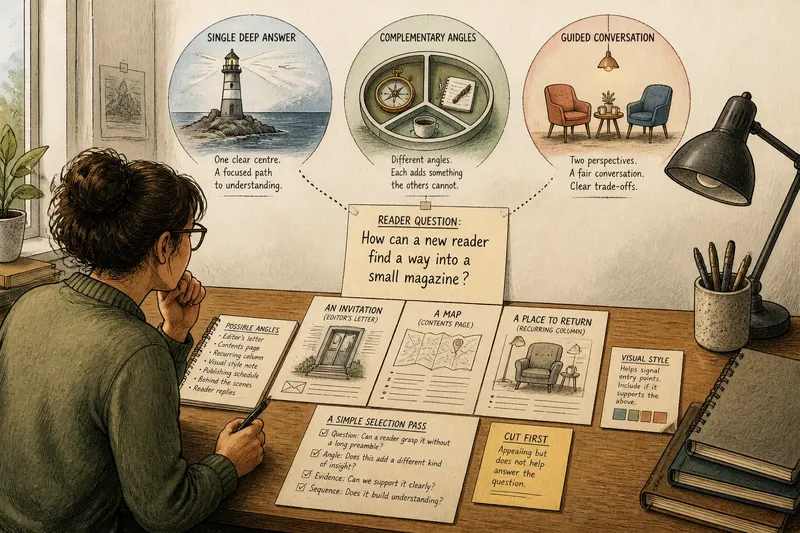
There are three workable shapes: a single deep answer, a set of complementary angles, or a guided conversation between differing views. Each can make a satisfying special edition, but they suit different questions, material and editorial energy. Choose the shape before gathering links and notes, and it becomes easier to spot what belongs outside the issue.
A single deep answer suits a question with one useful centre
Some reader questions point towards a decision or a practical difficulty: how do you keep a small publication recognisable without making every issue feel the same? A single-answer edition stays close to that problem. It might combine a short opening argument, a concrete method, a worked example and a closing prompt, all directed at the same reader need.
This approach suits an editor who has a strong, considered answer and enough material to make it specific. It also works when the question is narrow enough to answer honestly in one sitting. If the answer depends on several competing situations, forcing them into one neat prescription can make the issue sound more certain than the subject allows.
A useful test is whether each section changes the reader’s understanding of the same problem. A scene can make the issue vivid; a short explanation can name the tension; a practical suggestion can give the reader somewhere to begin. A detour into a related but separate subject may be interesting, yet still weaken the edition’s centre.
Complementary angles suit a question with several useful answers
Some questions are better opened up than settled. What makes an independent newsletter feel personal without becoming confessional? An editor might examine the voice of the writing, the rhythm of publication and the way a reader is invited to respond. These are distinct angles, but they all illuminate the same question.
This shape suits a subject with several parts that deserve room, or an editor who wants to make space for nuance without assembling a sprawling miscellany. Each angle should add something the others cannot. If two sections make the same point in different words, keep the stronger one and spend the freed space on a missing perspective.
Think of the issue as a tray with separate compartments: each item has its own flavour, but the arrangement still makes sense as a whole. The connection should be visible in the headings, transitions or short editor’s notes, not left for the reader to reconstruct. A brief opening question can establish the thread, while a closing paragraph can show how the angles fit together without pretending they settle every case.
A guided conversation suits a question shaped by disagreement
Some questions become clearer when two reasonable positions meet. Should a small publication prioritise a regular schedule or publish only when an idea is ready? A guided conversation could set out what each choice protects, where each creates friction and what a reader might consider in their own circumstances.
This format suits an editor who can represent both positions fairly and keep the discussion grounded in the question. It does not require a manufactured debate or a dramatic winner. A useful edition may show that the choice turns on the publication’s purpose, the editor’s available attention or the expectations already formed with readers.
Use this approach only when the difference is real and relevant. A forced opposing view can turn a thoughtful edition into a contest, while a fair comparison can help the reader see the trade-offs. Keep the scope modest: two voices or positions are often easier to follow than a procession of opinions, especially in a short special issue.
How should you choose the shape?
How narrow should the reader question be?
It should be narrow enough that a reader can understand what the issue is trying to answer, but open enough to support more than a slogan. If the question contains several separate problems, choose the one that matters most to this edition and save the rest for another time.
How many angles belong in one issue?
Include enough to make the answer feel considered, not so many that the reader loses the thread. A useful angle adds a distinct kind of help, such as context, a practical choice or a meaningful counterpoint.
Should you use reader contributions?
Use them when they sharpen the question and you can explain their role clearly. A short, permissioned contribution can bring a lived perspective; a collection of loosely related replies can shift the issue away from the question it promised to address.
What should you cut first?
Cut material that is appealing but does not help answer the question, even if it is polished or already drafted. If an item needs a long explanation to show why it belongs, that is a sign to reconsider it or give it a separate edition.
A simple selection pass keeps the edition coherent
Imagine you are preparing an issue around the question, “How can a new reader find a way into a small magazine?” You have notes on an editor’s letter, a contents page, a recurring column and a short note about the magazine’s visual style. The question suggests an edition about points of entry, not a general tour of every publishing decision.
You might choose three complementary angles: the editor’s letter as an invitation, the contents page as a map and a recurring column as a familiar place to return to. The visual-style note belongs only if it helps explain how those entry points are signalled. The observable result should be an issue whose sections feel connected when read in sequence, rather than a loose bundle of magazine-making observations.
For your own edition, write the reader question at the top of a working document. Under it, gather possible items, then give each one a plain-language reason for inclusion. “Interesting background” is not yet a reason; “helps a reader understand why this choice matters” is more useful.
- Question: Can a reader grasp it without a long preamble?
- Angle: Does this item add a different kind of insight from the others?
- Evidence: Can you support the point with a concrete example, observation or clearly framed opinion?
- Sequence: Does the item make sense where it sits, or does it interrupt the reader’s path?
- Cut: If it disappeared, would the answer become less helpful or less clear?
This is an editorial filter, not a demand for every issue to feel tidy. A surprising detail may belong if it deepens the reader’s understanding; a familiar section may need to go if it merely fills a slot. When details depend on permissions, contributor agreements or platform settings, check the relevant terms before publication.
Keep the invitation clear and the ending open
A weekend edition can feel special without becoming grand. Signal its shape in the subject line or opening note, then let the sections carry the promise. If the issue offers several angles, say so; if it follows one argument, make that path apparent. Readers should not have to guess why the material has been gathered together.
End by giving the reader a useful next thought rather than a verdict. You might invite them to notice which angle fits their own situation, or point towards a question the issue has made easier to ask. That small opening lets a focused edition feel complete without pretending the subject has been exhausted.
For a weekend issue built around one reader question, the best shape is the one that matches the question’s nature: a single answer for a tight problem, complementary angles for a layered one, or a guided conversation where the trade-offs matter. The editorial discipline is the same in each case: keep asking whether the next item helps this reader with this question, and let that answer decide what stays.